
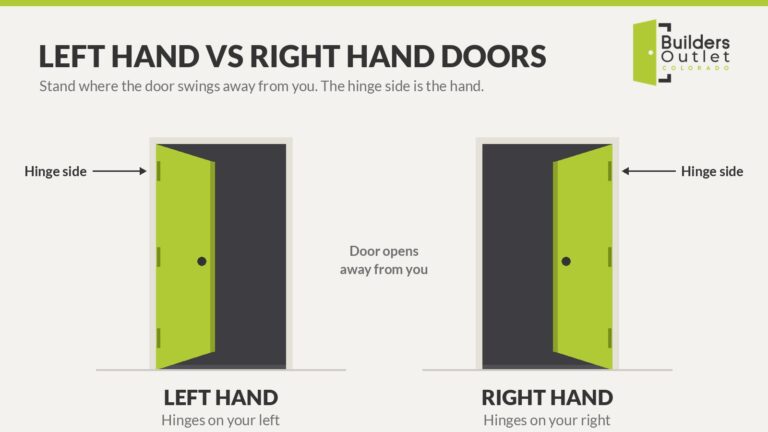
Stand on the side where the door swings away from you. If the hinges are on your left, it’s a left hand door. If they’re on your right, it’s a right hand door. A door that swings toward you when you stand outside is a reverse door: left hand reverse (LHR) or right hand reverse (RHR), also called left or right hand outswing. That’s the whole rule. Below is a chart for every case, the exterior door trap that gets people the wrong door, and what to pick when you order a prehung door from us.
How to tell if a door is left hand or right hand
- Open the door and stand where it swings away from you. You push it open from this side. For a bedroom or bathroom door, that’s usually the hallway.
- Look at the hinge side. Hinges on your left: left hand (LH). Hinges on your right: right hand (RH).
- Check it from the doorway. Stand in the opening with your back against the hinge jamb. If the open door is on your left, it’s left hand. On your right, right hand.
Not sure which side you’re on? Look for the hinge barrels. On a standard door you can see the round knuckles from the side the door swings toward. If you can see them, you’re on the pull side. Walk through to the other side and look again.
From the pull side, the knob tells you instead: knob on your left means a left hand door, knob on your right means right hand. Both checks give the same answer. Mixing them up (hinges from the pull side, or the knob from the push side) is how most people end up with the opposite door.
Door handing chart: LH, RH, LHR and RHR
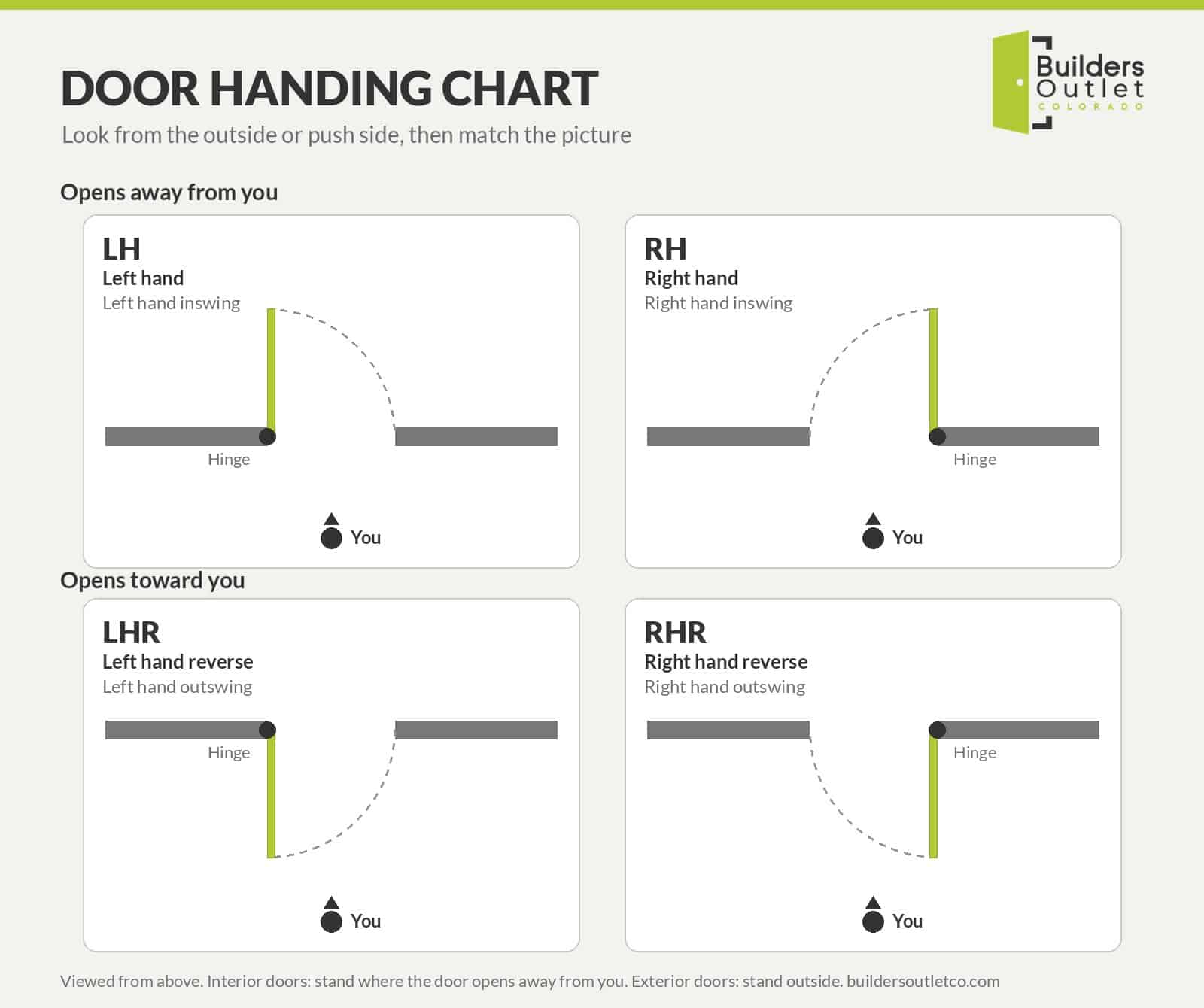
| Code | Name | Where you stand | What you see | Also called |
|---|---|---|---|---|
| LH | Left hand | Push side or outside | Hinges left, opens away from you | Left hand inswing |
| RH | Right hand | Push side or outside | Hinges right, opens away from you | Right hand inswing |
| LHR | Left hand reverse | Outside | Hinges left, opens toward you | Left hand outswing |
| RHR | Right hand reverse | Outside | Hinges right, opens toward you | Right hand outswing |
The residential makers agree with this. JELD-WEN’s prehung install guide says to face the door from the side where you can’t see the hinges, and a left handed door opens to the left. Masonite’s guide names the hand from the room the door opens into, and its measuring page uses the back to the hinges check. Done right, all three land on the same answer as the chart.
Interior doors: which side to stand on
For an interior door, stand on the side it swings away from. Most bedroom, bathroom and closet doors swing into the room, so stand in the hallway and look at the hinges.
Two choices set the hand of a new door: which jamb the hinges go on, and which room the door swings into. Decide both before you order. Put the door where it won’t hit a light switch, a vanity or another door, and where it opens against a wall.
Turning a prehung door around doesn’t change its hand. Flip a left hand unit and install it from the other side of the wall, and it’s still left hand. It now swings into the hallway with the hinges on the other jamb. If you need the hinges on the same jamb and the swing into the room, you need the other hand.
Exterior doors: always name the hand from outside
Exterior doors are handed from outside the house, whichever way they swing. Lowe’s RELIABILT team says so for entry doors, Andersen says so for patio doors, and commercial hardware is handed the same way.
- Inswing (most front doors): stand outside. The door opens away from you, so the rule is the same as an interior door. Hinges on your left: left hand inswing.
- Outswing: stand outside. Now the door opens toward you and you can see the hinges. Hinges on your left: left hand outswing (LHR).
Here’s the trap. A left hand outswing door looks like a right hand door from inside the house. If you stand in the living room, push it open and read the hinges, you’ll order the wrong one. Walk outside first.
Outswing doors put the hinge pins on the outside, where they can be pulled. Ask for security hinges or non removable pins on any outswing door.
We sell exterior and front doors in the showroom, not in the online shop. Bring the hand, the swing and your measurements and the counter will match the door.
Commercial doors: why LHR and RHR matter
Commercial work uses the BHMA standard. You stand on the outside, meaning the secure or keyed side, such as the corridor side of an office door. The door opens away from you: LH or RH. Toward you: LHR or RHR.
The reverse codes matter because the latch bevel has to face the way the door closes, and locks, exit devices and closers each have to be set up for the door. That’s why commercial specs list the hand on every opening. Panic bars are always listed as LHR or RHR, because exit devices go on doors that swing out.
Do door handles have a hand?
Round knobs don’t. They work on any door. Lever handles often do, because the lever has to point toward the hinges at rest. Many levers are reversible, and some must be ordered as left or right. Check the box before you buy, and bring your door’s hand when you shop hardware. Emtek, for one, says its knob sets need no handing but its levers do.
Double doors, French doors and sliding doors
- Double and French doors: a pair is named by its active leaf, the one with the lockset that opens first. Stand on the push side or outside, find the active leaf, and use the same rule.
- Sliding patio doors: there are no hinges, so the hand comes from the panel that moves. Andersen names it from outside the house: operating panel on your left is a left hand door. Brands don’t all describe it the same way, so check the maker’s spec sheet.
- Barn and pocket doors: they slide on a track, so there’s no swing hand to order. Order the size.
Can you change a door’s hand?
Yes, but on a prehung door it’s real work. The hinge mortises move to the other side of the jamb and the door, the strike moves, and the slab may need a new bore for the latch. An exterior door may also need its lock edge bevel changed. It’s almost always cheaper and faster to buy the right hand.
If you’re keeping the frame you have, order a slab and hang it to match the existing hinges. Measure the old slab first with our door size guide.
How to order the right prehung door from us
Every interior door in our online shop comes as a slab, a right hand prehung or a left hand prehung. Pick these five things:
- Size. Width x height, like 30 x 80. Not sure? Use the standard door size chart.
- Hand. From the side the door swings away from, using the rule at the top of this page.
- Slab or prehung. Prehung comes hung in its frame. A slab is the door alone, for an existing frame.
- Jamb. Online prehung doors come with a standard 4 9/16 inch finger joint pine primed jamb. For a thicker wall, reach out to our mill shop.
- Hinge finish. US15 brushed nickel, US1 black or US10B oil rubbed bronze.
Left and right cost the same. A 1 panel shaker primed solid core door in 30 x 80 is $119.99 as a slab and $239.99 prehung, either hand, in our shop as of November 28, 2026. Browse every style on our interior doors and prehung doors pages.
Still not sure? Call (303) 789-0808, or stop by the showroom at 775 Canosa Court in Denver with a photo of the opening taken from the side it swings away from. Contractors buying for a whole house should look at our Pro Membership.
Mistakes we see
- Reading the hinges from the pull side. You get the opposite hand. Stand where the door swings away.
- Using the knob from the push side. Some guides tell you to look at the knob. That only works from the pull side.
- Naming an outswing door from inside. Exterior doors are named from outside.
- Flipping a prehung to fix the wrong hand. It still has the same hand. It just swings into the other room.
- Forgetting the hardware. A handed lever or a closer has to match the door.
Questions we hear
Is a left hand door hinged on the left?
Yes, when you stand on the side it swings away from. From the other side the hinges look like they’re on the right, which is why the side you stand on matters.
Which way does a right hand door open?
Away from you, with the hinges on your right, when you stand on the push side. It swings open to the right.
What’s the difference between left hand and left hand reverse?
Both have the hinges on the left. A left hand door opens away from you. A left hand reverse door opens toward you, which is the same as a left hand outswing door on a house.
What does a left hand inswing door look like?
From outside, the hinges are on your left and the door opens into the house, away from you. It’s the most common front door setup.
Do I need a left or right handed door handle?
Not for a knob. For a lever, check whether it’s reversible. If it isn’t, order it for your door’s hand.
Is door handing the same for every brand?
For swinging doors, yes. JELD-WEN, Masonite and the BHMA standard all land on the same answer when you stand on the push side or outside. Sliding patio doors are named by the moving panel, so check that maker’s spec sheet.
Can I use a left hand door for a right hand opening?
Not as a prehung without moving the hinges and strike. Flipping it changes which room it swings into, not its hand.
Recent Comments